
Emergency Radio – When Disaster Strikes
!!! Before we begin we want to stress the importance of making this critical decision now !!!
With the tariffs in place, we have no idea how this will affect the cost of these radios in the near future. If you want too long, you may end up paying double the price on most if not all of these radios listed.
Emergency radio communications is more than a backup—they become a lifeline. While commercial systems fail, amateur and GMRS radios can remain fully operational, providing real-time updates, organizing local response, and keeping families informed.
Without them, people are left guessing about the nature of the crisis, about when help might arrive, and about how to protect those they care for.
You can buy emergency weather radios for very little cost but why? You can only listen to a weather alert radio. You can not call for help or talk with your neighbors in other emergencies.
You are going to spend anywhere from $40 to $100 on a weather alert radio and for just a few bucks more you can have a real emergency radio to listen in and talk to people when things begin to get serious.
By getting a real emergency radio that allows you to communicate with others, you just increased your chances of safety and survival by 50% if not more. Don’t be caught off guard, learn which is the best emergency radio to use and get yours today.
Emergency Radios 101
What is the best emergency radio for me? How do you even prepare for this? Do you go out to Walmart or your local sporting goods store and buy the first set of radios you find? While that might work for communications around the house or within a city block, this option will do you no good for long range communications.
That is the entire purpose of this manual. To prepare you and arm you with the knowledge required to communicate effectively and potentially save your life or the lives of others.
Choosing the best emergency radio for the job can be a daunting task. Should you use a dual band radio or one dedicated to GMRS only? Should you worry about the license? What kind of antenna do I need?
These are all real world concerns. There are so many options and that leads to many people often spending money on things that will not work or simply will never fill their needs.
So let’s address the license first and get that out of the way. To use Amateur radio you do indeed need a license. The same applies for using GMRS radio. Later in the article we will explain how to obtain these.
First let’s look at this from a disaster perspective. During a true life or death scenario the concerns for a license are out the window. This is not to say that you can transmit on these frequencies in ANY emergency situation.
What type of emergency would qualify? That would largely depend on the scale of the impact this emergency will have. Are the neighbors in the next town about to lose homes due to massive flooding? (potential life threatening situation.
In this scenario the FCC may overlook your unauthorized use. The transmitting of critical information might help save lives and hundreds of thousands of dollars.
You transmit on these frequencies to tell everyone that highway 25 is shut down due to trees down. You will probably get a really nasty letter from the FCC and perhaps even some fines. This would not qualify for “Dire Situation”. In this case the band that would attract the least attention would be GMRS. Amtateur radio frequencies will probably get you in hot water.
There has been a power outage lasting several days, you need to contact your family to see if they are ok. This may not apply as an acceptable unlicensed use. Now if this event has gone for a week and food is running short, you need assistance. Then in that case you may be able to get a help request out and not suffer the consequences.
If this event has gone on for more than a week then it’s a pretty sure bet the FCC is not going to be concerned about the use.
So is it a good idea to get that license? Indeed it is because then you will not have to worry about what is acceptable and what is not. You can keep up with matters that are not an actual life or death situation. You can obtain updates from other users and stay on top of what is going on.
Now let’s talk about radios and what you are going to need in your toolkit. This will depend largely on what your intentions are. If you are looking for around the home or property use it will require minimal investment. If you are looking across town or city to city then you will be looking at more powerful and more expensive radios.
Around Home Use – FRS – GMRS
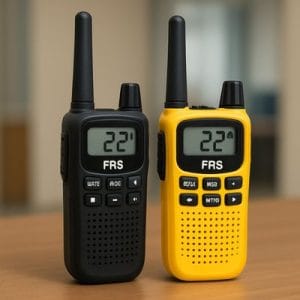
The most basic and license free emergency radios are FRS or Family Radio Service. These are designed for around the home of property, camping trips, amusement parks etc. These will allow your family to stay in touch over a short range. The range will depend on obstructions in the line of sight.
Line of sight is a term to keep in mind for this entire document. This refers to point to point between two antennas. Buildings, trees and terrain can obstruct the line of sight. FRS radios typically get ½ to 2 miles depending on line of sight. A higher elevation well above terrain and obstacles can ideally get up to 10 or 15 miles. I have personally talked to radios up to 30 miles from high elevation (3200 ft).
FRS radios operate in the UHF frequency range of 22 channels, 462 – 467 Mhz range overlapping with GMRS channels 1-7 and 15-22. FRS can only use a max of 2 watts while GMRS can use higher power. Mobile, base and repeater stations can use up to 50 watts while handles are limited to 5 watts.
So for a no license, around the home or property, camping or field trips, FRS radios are a very cheap option but are also very limited. For $30 per ten years you can obtain a GMRS license (yes the entire family is covered) and you get a greater range of power use and still be able to communicate with FRS users.
Across town or City to City use.
This is where GMRS begins to shine when used as emergency radio communications. The use of higher power and ability to use repeaters can extend your range greatly. A good handheld GMRS with a good antenna can slightly better range due to the fact it is using 5 watts output. Typically 1-5 miles in urban areas and 5-10 miles in suburbs with less obstacles. Open terrain with a good line of sight can obtain up to 15 miles. High elevations can see ranges of 10-30 miles even if hilly terrain is present. Remember if the two can “see each other” they can talk. Now consider a 50 watt mobile with a good antenna you achieve 5-10 miles in urban areas, 10-20 in less obstructed suburban areas and up to 30 miles in open terrain. Higher elevations can see 50 plus miles easily.
Wider Use Case – Amateur Radio
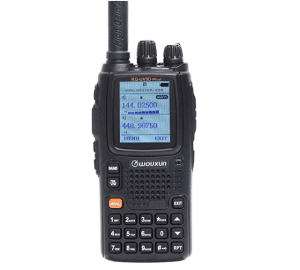
Amateur radio allows you to operate on 2 meter or VHF as well as 70cm UHF. This can greatly extend your communications as there are so many repeaters out there. The use of VHF also extends the range of a radio as it tends to travel farther. A VHF signal will often reach 2-3 times farther than UHF (GMRS). In ideal conditions you can get up to 30 plus miles LOS (Line of sight) in level terrain.
If you are truly into emergency prepping and emergency radio communications then I strongly suggest opening the door to Amateur radio. Many repeater owners do Emergency Nets during times of crisis. It will also open up the number of potential contacts you may have when disaster strikes.
GMRS and Ham Antennas
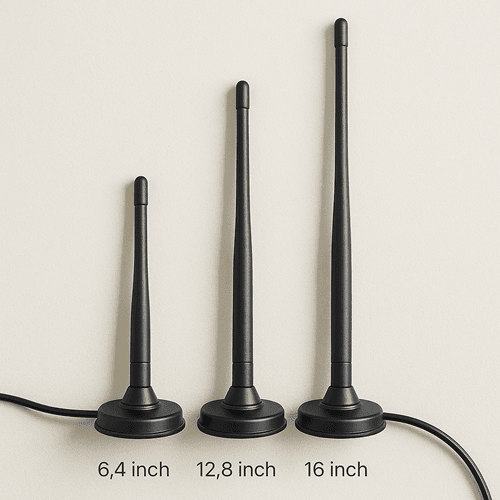
Before we get into which emergency radio you should buy, let’s talk about antennas. A radio is only as good as its antenna. An expensive 50 watt mobile with a crappy antenna will be a crappy radio but with a great antenna it can be a superb radio. Likewise a $50 radio with a $200 antenna can perform like a $200 radio. So what do you look for in an antenna?
Too many people just run out and buy an antenna never understanding SWR or ERP and end up getting crappy signals and or destroying the radio. The good news is that you can often buy these pretuned for your operating range. A big misconception is that a longer antenna is a better antenna. This is not the case (mostly). Antennas are often defines as ⅝, ½, or ¼ wave.
You want to get an antenna that is “tuned” for your desired frequency or frequency range. By tuned we mean that the antenna is set to a certain length in order to maximize the power output on that frequency. This is done using an SWR (standing wave ratio) meter. It will be tuned to the point that you have a 1.0 – 1.5 SWR (excellent) or 1.5 – 1.9 (good) SWR. This allow all the power to be efficiently radiated from the antenna ERP (Effective Radiated Power).
Here are the average lengths for different antenna types, in order of best use assuming operation in the UHF GMRS frequency range (~462 MHz) Included is DB gain (discussed later here):
- 5/8 Wave – About 15 inches (38 cm) Higher DB gain
- 1/2 Wave – Around 12 inches (30 cm) around 2.5 DB gain
- 1/4 Wave – Roughly 6 inches (15 cm) 0 DB gain
So one might think 15 is good then 30 is better. That is not the case (sort of). It is best to stick to the traditional ⅝ wave (15 inches) unless you are looking at using VHF frequencies. We will discuss VHF frequencies in a later article but the general lengths for commercial band are 17.3, 34.6 and 43 inches.
What is DB Gain?
Think of dB gain like a flashlight. A basic flashlight shines its light evenly in all directions—this is similar to an antenna with 0 dB gain, like a 1/4 wave antenna.
Now, imagine upgrading to a stronger flashlight that focuses more light in a specific direction instead of wasting it everywhere. This is like a higher dB gain antenna—it concentrates more radio signal toward the horizon, improving distance and clarity.
Here’s a simple breakdown:
- 0 dB gain (like a 1/4 wave antenna) – Signals go in all directions, but aren’t very strong.
- 2 dB gain (like a 1/2 wave antenna) – Slightly stronger signal, travels further closer to the horizontal plane.
- 3 dB gain (like a 5/8 wave antenna) – More power directed outward on the horizontal plane, better range.
Higher gain antennas don’t create more power, they shape the signal to make better use of it!
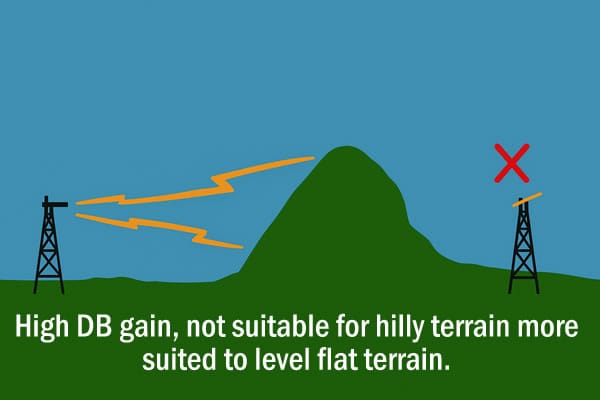
So in an area with little obstruction, a high DB gain antenna will focus power along the horizontal plane and for a longer distance but may not be able to reach destination over obstacles like hills or mountains. A lower DB gain will have a better chance of arching the signal enough that it may reach that destination.
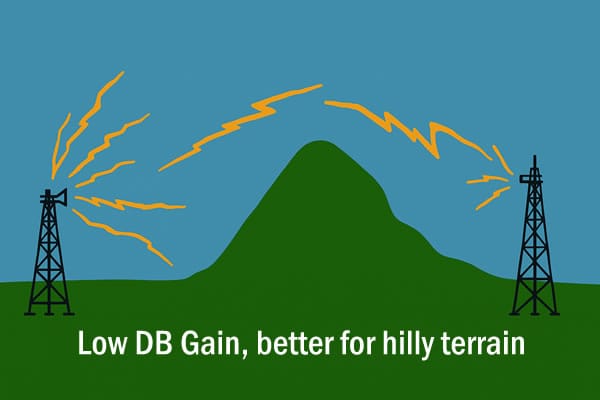
Think of dB gain like a flashlight. A basic flashlight shines its light evenly in all directions—this is similar to an antenna with 0 dB gain, like a 1/4 wave antenna.
In the The Low DB Gain image you notice that the signal radiates in all directions. This allow the signal to “arc” and reach over obstacles, hills or mountains to reach the repeater or other radio operator.
Remember from our antenna section above, the 1/4 wave or 6 inch antenna is a low DB gain suitable in this environment.
Now, imagine upgrading to a stronger flashlight that focuses more light in a specific direction instead of wasting it everywhere. This is like a higher dB gain antenna—it concentrates more radio signal toward the horizon, improving distance and clarity.
Now we said higher DB does not create power, that is true but they do perform in a way that one can figure a power equivalent. This power output is known as Effective Radiated Power or ERP.
So a 5 Watt radio with a 5.5 DB gain antenna will act like a 17-18 watt radio. The equation to figure this is a bit complicated so we will ignore that for now and focus on the what and why of the matter.
So if you use a 25 watt radio your ERP would be like using an 89 watt radio. Again the power is not increased, it is simply focused more along the horizontal plane thus going further.
Yagi vs Omni Directional
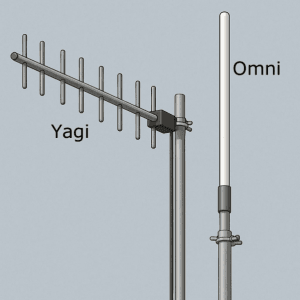
While we are on this topic let’s mention Yagi vs Omni directional antennas.
Omni directional sends signals out in all directions (handheld, mobile and base antenna). Good for reaching contacts in different locations or moving contacts.
But what if you are talking Base to base in one direction? Then you may want to consider a Yagi antenna. A Yagi will focus the radio signal in one direction. You can adjust it and dial it in to the point that the signal is at its best.
The good news here is you can build a very effective Yagi antenna using a simple metal tape measure and some PVC pipe.
Tape Measure Yagi Beam Antenna – Ham Radio Q&A
These are also available in various locations prebuilt but always make sure you are getting the right antenna. I would suggest using a reputable source because Ebay and Amazon tend to be less reliable. The Antenna Farm is a good source.
The Best Emergency Radio
So now we have a good idea about the types of radios, a little about antennas. Let’s take a look at which radio you might need. We are going to skip FRS radios because they are so widely available. Instead we will focus on GMRS and Amateur radios.
There are a ton of them out there so we will look at what we have found to be the most reliable and most effective.
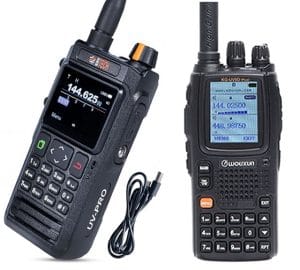
In today’s emergency radio market I personally would rate Btech and Wouxun radios to be the best emergency radio for 2025. Both companies offer good quality build, dual bands (VHF and UHF) which include ability to monitor emergency services, HAM radio and be able to talk to GMRS and FRS.
While many argue it is illegal to use these, the reality is that to date there have never been an FCC case charging anyone for using these and probably never will be.
Handheld Emergency Radio’s
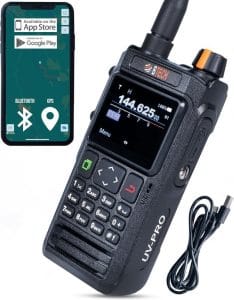
The best hand held radios on the market are the Btech UV-Pro Dual band radio priced at $164.99 this radio boasts Dual Band VHF/UHF Two-Way Radio – APRS, Bluetooth, GPS, Text Messaging, Aviation Band Scanner, NOAA Weather Alerts, and USB-C Rechargeable Battery. The actual weather alerts are a super bonus.
The GMRS-PRO version comes in at $159.99 but lacks the ability to do VHF frequencies. Considering that I rate the UV-PRO to be the best emergency radio option.
UV-82HP 8 Watt
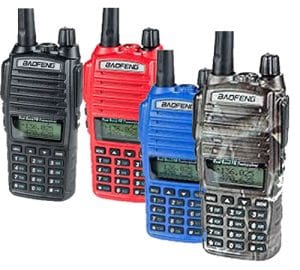
The next in the lineup is the Baofeng UV-82HP commercial dual band radio pushing 8 Watts and priced at $64.89, it can also monitor both bands as well as FM radio stations. This radio does not have Weather alerts however it can monitor NOAA weather frequencies making it an ideal budget emergency radio.
The radio has a simple basic look, easy to operate and while it has less bells and whistles I might be a good fit for those wanting something simple. Comes in black, red, blue and camo.
KG-UV9PX 10 Watt
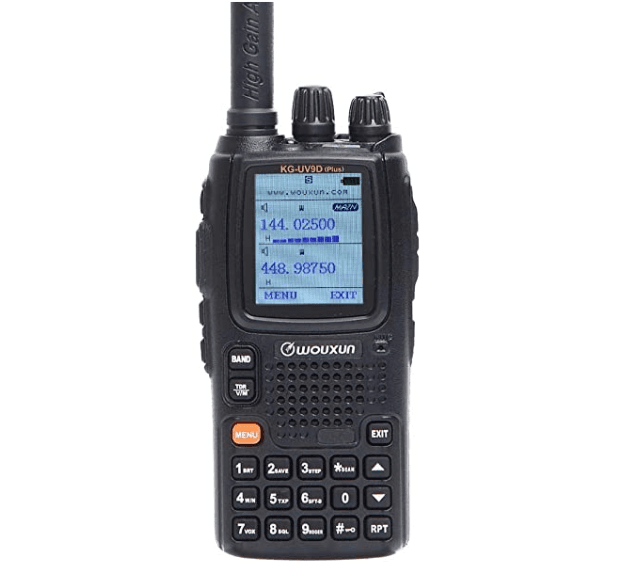
This is technically a ham radio but used by many people for emergency purposes. Upgraded 10 Watt, 999 Channel Dual-Band Pre-Programmed Superhet VHF/UHF Emergency HAM Two-Way Radio & 7-Band reception: 76 mhz to 960 mhz includes FM radio, AM Air, 220, 2m and 440 which is the most used.
This is among the top rated radios and is sure to do anything you may require along with a rugged build. We would rate this up there with the Btech radios any day.
Best Mobile Emergency Radios
In this lineup we consider the Btech Radios the best option overall due to the fact they have customized upgraded firmware and are a USA based company. Support seems to be good and most users report all good things about Btech radios. While the Wouxun radios are great radios, they are often not supported as well and are often shipped from overseas. Not to say they are not good radios, we just prefer Btechs locally owned company and support.
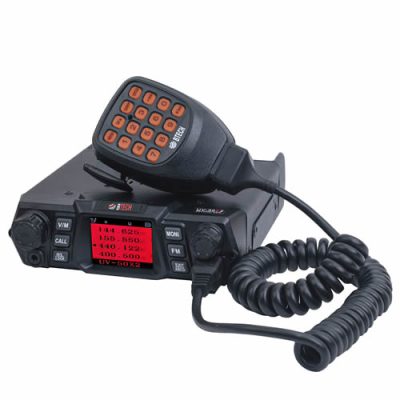
This dual band (VHF/UHF)radio boasts 50 Watt output however many users are reporting higher outputs. SOme reports have shown this radio operating at 77 Watts output on VHF and around 60 Watts on UHF. Even at 45 Watts this radio would be ideal for mobile or base station use. The UV-50X2 operates as multiple radios in one, with either 144 MHz or 430 MHz as the “Main” TX/RX band, while simultaneously watching up to 3 other frequencies or channels; and, if you like, you can configure your UV-50X2 for simultaneous VHF-VHF or UHF-UHF operation, too!
Btech also has the Btech 25×2 25 Watt radio for $124.89
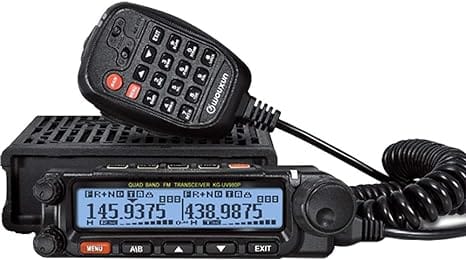
The UV-980P is in stock for $329.99. While Wouxun is solid and I have owned one myself for many years, I still have to lean toward Btech due to price but the extra bands and detachable face make this radio a beast. The Wouxun 980P is a rock solid radio so if you don’t mind the price then yes I would suggest you nab one fast before prices skyrocket
QUAD BAND!! DUAL SPEAKERS!! CROSS-BAND REPEATER!!The Wouxun KG-UV980P is a new Quad Band base/mobile two way radiom detachable face and packed with a plethora of features at an unbelievably affordable price. With four band transmission and eight band reception, this powerful radio delivers up to 40 watts UHF and 50 watts VHF for maximum range and power at extremely low cost!
If you have questions about radios or wondering which one will be best for you, we are open to helping you out. We operate the Tennessee Emergency Situation Report on Facebook and you can contact us there or reach out from TNESR.Org
Want to learn about emergency foods in case of a disaster or power failure? Check out our Legacy Food Storage line